Phone-call captioning apps, compared — and what they can't do
CaptionCall, ClearCaptions, InnoCaption, Rylo, and Rogervoice all caption your phone calls — free for eligible US users, paid for by a federal program. Here's how the five compare, who qualifies, and the one conversation none of them may caption.
By Lilly Seay · Updated July 6, 2026

If phone calls are hard to hear, the United States has a genuinely great deal for you: five services will caption your calls at no cost, funded by the FCC. They differ in the details — home phones vs apps, human stenographers vs automatic captions, languages, platforms. But they all share the same boundary: the federally funded service covers phone calls only, so none of them may caption the conversation happening in the room with you. For that part of your day, you want a live-captioning app like Hearing Buddy — and honestly, most people should have one of each.
- For your calls: pick one of the five FCC-funded services below — free for registered, eligible US users.
- For the room: a call-captioning service can't follow you to the dinner table. In-person captioning is Hearing Buddy's entire job.
- The paperwork: the free call services require federal registration — name, date of birth, last four digits of your SSN, address, and a hearing-loss self-certification. That's the law, not the companies being nosy.
How free call captioning actually works
All five services are "IP-CTS" providers — Internet Protocol Captioned Telephone Service. Behind the jargon is a simple, rather wonderful arrangement.
The FCC pays, you don't
Providers are reimbursed for every eligible captioned minute from the Interstate TRS Fund, which the FCC administers and telecom companies pay into. For you that means no subscription, no per-minute charges, and in CaptionCall's and ClearCaptions' case, even the home caption phone hardware is free.
Registration is federal, not optional
FCC rules (47 CFR 64.611) require every provider to collect your full name, date of birth, last four digits of your SSN, address, and phone number for the federal TRS User Registration Database — plus a self-certification of hearing loss signed under penalty of perjury. Every provider shows the same notice: federal law prohibits anyone but registered users with hearing loss from using captioned telephones with captions on.
US-only, phone-calls-only
IP-CTS is defined by FCC rule as a relay service for reading captions of the other party on a telephone call, and the fund only compensates providers for eligible calls. So the free service is US-only and covers phone calls only — it doesn't extend to the conversation happening in the room. More on that gap below.
The call-captioning lineup
| Service | What you get | Captions come from | Platforms | Cost | In-person conversations? |
|---|---|---|---|---|---|
| CaptionCall Sorenson Communications | A free home caption phone (delivery and installation included) plus the CaptionCall Mobile app — formerly Olelo — showing live captions of both sides of your calls. | Automatic speech recognition | Home caption phone; mobile app on iOS 15+ and Android 9+ | Free for registered, eligible users (FCC TRS Fund) | Phone calls only |
| ClearCaptions ClearCaptions, LLC | A free captioned home phone that needs only home internet — no landline — plus the ClearCaptions Mobile app and a personal ClearCaptions number. English and English/Spanish bilingual captions. | Near-real-time captioning | Home caption phone; mobile app on iPhone and iPad only — there is no Android app | Free for registered, eligible users (FCC TRS Fund) | Phone calls only |
| InnoCaption Mezmo Corporation | App-based call captioning with your choice of live stenographers or automatic captions — you can switch mid-call. Captioned voicemail and saved call transcripts included. | Live stenographers (CART) or automatic speech recognition | iOS 15.1+ and Android | Free for registered, eligible users (FCC TRS Fund) | Its help center says in-person use is against IP-CTS rules |
| Rylo Nagish Inc. — formerly Nagish | App-based call captioning, rebranded from Nagish in June 2026. In-app caption languages include English, Spanish, French, Japanese, Hebrew, and Italian. | Automatic speech recognition | iOS and Android | Free for registered, eligible US users (FCC TRS Fund) | Calls are the funded service; a separate on-device Live Transcribe feature covers in-person, outside the FCC program |
| Rogervoice Rogervoice | App-based call captioning; you can also type replies and the app speaks them aloud in a voice you choose. 100+ caption languages internationally, E911-compatible in the US. | Automatic speech recognition | iOS 16+ and Android | Free for registered, eligible US users; paid subscriptions outside the FCC program | Phone calls only |
Details verified July 6, 2026 from each provider's website, terms, and App Store listing. FCC-funded services change — confirm current details with each provider before signing up.
Which one fits your calls?
All five do the core job well. The right pick comes down to whether you want a home phone, a human on the line, or a specific language.
CaptionCall
The home-phone heavyweight
Sorenson’s IP-CTS service comes in two forms: the classic CaptionCall home caption phone — the device, delivery, and installation are all free — and the CaptionCall Mobile app (rebranded from Olelo in late 2023), which captions both sides of your calls and works with Bluetooth hearing aids. A good fit if you want a dedicated caption phone on the kitchen counter and an app in your pocket from the same provider.
iOS app rated about 4.8 stars across 3.3K ratings and actively updated, as of July 6, 2026.
ClearCaptions
The flagship is the phone on your desk
ClearCaptions centers on its free captioned home phone, which needs only your home internet — no landline — and gives you a personal ClearCaptions number. Captioning is available in English and English/Spanish bilingual. Worth knowing: the mobile app is iPhone/iPad only (there is no Android app) and hasn’t seen an update since December 2023, so think of this one as a home-phone service first.
FCC granted ClearCaptions full IP-CTS certification on March 10, 2026, running through March 10, 2031.
InnoCaption
The only one with humans on the line
InnoCaption is the most hard-of-hearing-native brand in the group, and the only one where you can choose a live stenographer to caption your call — or automatic captions — and switch between them mid-call. Recent versions added custom word lists and picture-in-picture captions. If accuracy on important calls is your top priority, the human option is a real differentiator.
Full FCC certification since December 2022 (through December 2027); about 10,850 App Store ratings at roughly 4.7 stars as of July 6, 2026.
Rylo (formerly Nagish)
The newest name, with an in-person side feature
Nagish rebranded to Rylo on June 9, 2026 after an $85M raise — help pages and reviews still say Nagish, so both names refer to the same app. It captions calls in multiple languages and, uniquely in this group, ships a built-in Live Transcribe feature for in-person conversations. That feature runs on your device as a side feature outside the FCC-funded service — the funded part is still calls only.
Rated 4.7 stars across roughly 2,960 US ratings as of July 6, 2026; expect some post-rebrand rough edges as 2.0 updates settle.
Rogervoice
The international one
Rogervoice, a French company founded in 2014, captions calls in 100+ languages internationally and lets you type replies that the app speaks aloud in a voice you choose — handy if you prefer not to voice calls yourself. In the US it’s free for registered eligible users through the FCC program; elsewhere it sells subscriptions, making it the only option here with a path for users outside the US.
FCC-certified IP-CTS provider (conditional certification since 2024); launched US operations April 2026. Rated about 4.8 stars across 1.4K US ratings as of July 6, 2026.
The one conversation none of them may caption
Here's the boundary every service on this page shares, and it's worth understanding because it isn't a flaw — it's the deal. The federal fund that makes these services free exists specifically for telephone communication. IP-CTS is defined by FCC rule as a relay service for reading captions of the other party on a phone call, and providers are only compensated for eligible calls. The upshot: the federally funded captioning service covers phone calls only — it can't be used to caption in-person conversations.
The providers say so themselves. InnoCaption's help center states it plainly: "It is against the law to use the service as a substitute for hiring an in-person captioner to provide access." ClearCaptions' terms say the service is "not intended for use… as a monitor, intercom, or for transcription purposes other than for eligible IP CTS calls." Rylo is the one that acknowledges the gap in-product — its Live Transcribe feature for in-person conversations runs on your device as a separate side feature, outside the funded service.
So when you hang up and walk back into the kitchen, the doctor's office, or the family dinner — the free federal program has done its job, and something else has to pick up. That something is a live-captioning app that listens to the room through your phone's microphone.
Hearing Buddy captions the room
Hearing Buddy is built entirely for the conversations the call services can't touch: unlimited free captions of the world around you, processed 100% on your iPhone — no audio ever leaves your phone, and it works offline. There's no registration, no eligibility forms, no SSN digits, and it works in any country.
- Unlimited free captions — no meters, no session caps
- Caption Together: free group captioning between iPhones in the same room, peer-to-peer with no internet needed, each person's words attributed by name in their color — and everyone can read the room in their own language
- A tap on your Apple Watch when someone says your name or asks you a question (Buddy+)
- Captions in 8 languages, with on-device live translation into 10 reading languages
Fair is fair: Hearing Buddy can't caption phone calls — iOS doesn't give microphone apps access to call audio, so no app like ours can. It requires iOS 26 or later, it's Apple-only (iPhone, Apple Watch, Mac, and Vision Pro), and Caption Together works with people in the same room, not remote callers. That's why the honest setup is both: one of the five services above for your calls, Hearing Buddy for everything else.
Download free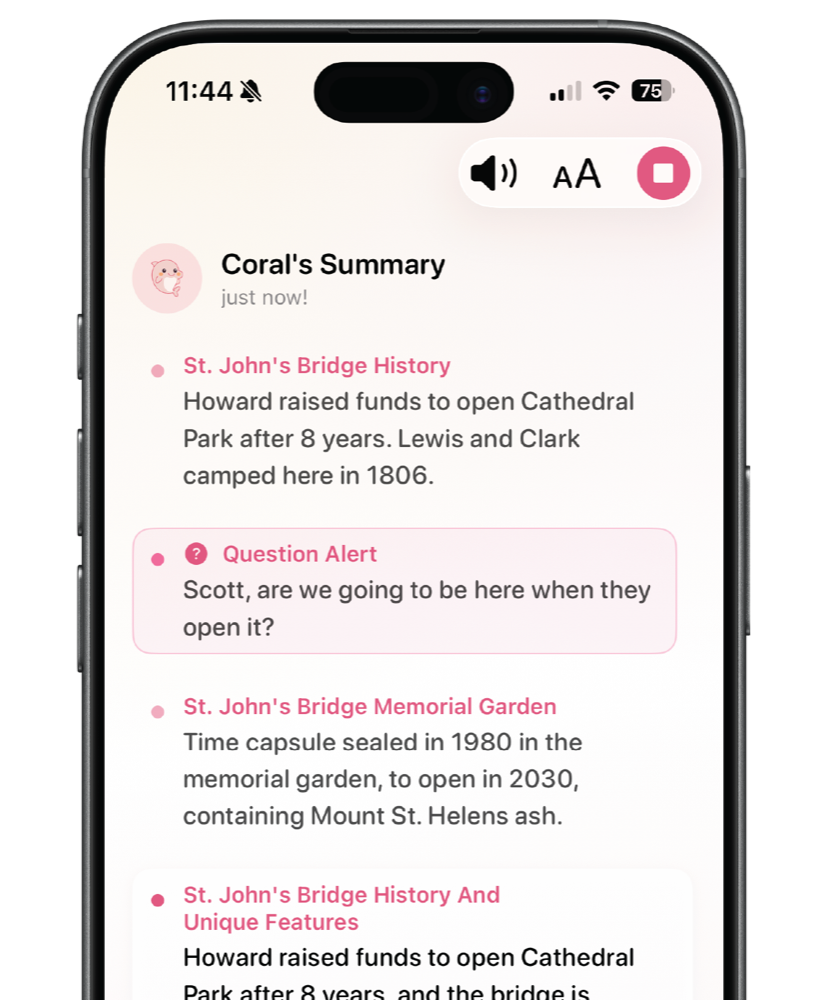
Questions & answers
Yes — for eligible users in the United States. CaptionCall, ClearCaptions, InnoCaption, Rylo, and Rogervoice are all compensated through the FCC-administered Telecommunications Relay Services (TRS) Fund, which collects fees from telecom companies. Eligible registered users pay no subscription and no per-minute charges. The one wrinkle: Rogervoice also sells paid subscriptions for people outside the FCC program, such as international users.
People in the United States whose hearing loss makes captions necessary to use the phone. Each provider requires registration and a self-certification of hearing loss, signed under penalty of perjury — federal law prohibits anyone but registered users with hearing loss from using captioned telephones with the captions turned on. There is no audiogram requirement or doctor’s note in the standard process; you certify your own hearing loss.
Because federal rules require it, not because the companies want it. FCC rule 47 CFR 64.611 requires IP-CTS providers to collect your full name, date of birth, the last four digits of your Social Security number, residential address, and phone number, and submit them to the federal TRS User Registration Database. Every legitimate provider in this space asks for the same information — it’s how the FCC verifies that fund money goes to eligible users.
No. IP-CTS is defined by FCC rule as a relay service for reading captions of the other party on a telephone call, and the TRS Fund only pays providers for eligible calls — so the federally funded service covers phone calls only. InnoCaption’s own help center says using it as a substitute for in-person captioning access is against the law, and ClearCaptions’ terms say the service is not intended for use as a monitor, intercom, or for transcription beyond eligible calls. For conversations in the room, use a dedicated live-captioning app like Hearing Buddy.
They’re the two big home-caption-phone services, and both are free for registered eligible users. CaptionCall (Sorenson) offers a free home phone plus a mobile app on both iOS and Android. ClearCaptions offers a free home phone that needs only home internet, plus a mobile app that is iPhone/iPad only — there is no ClearCaptions Android app. ClearCaptions also received full FCC certification in March 2026, running through 2031. If you want a caption phone and you use Android, CaptionCall is the more natural pick of the two.
The free, FCC-funded service is US-only — the TRS Fund can only pay for eligible US users, which is why registration requires a US address. Rogervoice is the exception with an international path: it sells subscriptions outside the FCC program and captions calls in 100+ languages. For in-person captions, Hearing Buddy works in any country — no registration, no eligibility forms, and captions are generated on your iPhone.
A call-captioning service isn’t the tool for this — the FCC-funded services cover phone calls only. Rylo includes an on-device Live Transcribe side feature, and Hearing Buddy is built entirely for this job: unlimited free captions for the room around you, processed 100% on your iPhone so no audio leaves your phone, working offline, with no account or registration. Caption Together adds free group captioning across iPhones in the same room, with each person’s words attributed by name.
No — and no microphone app can. iOS doesn’t give microphone apps access to call audio, so captioning a phone call requires a dedicated relay service like the five on this page. That’s exactly why the honest setup is both: one of these free FCC-funded services for your calls, and Hearing Buddy for every conversation that happens off the phone.

Five apps for your calls. One for everything else.
Pick a free FCC-funded service for the phone — then let Hearing Buddy caption the rest of your day. No account, no paperwork, no strings.
Available on iPhone & Apple Watch · Requires iOS 26+
CaptionCall is a trademark of CaptionCall, LLC, a Sorenson Communications company. ClearCaptions is a trademark of ClearCaptions, LLC. InnoCaption is a trademark of Mezmo Corporation (dba InnoCaption). Rylo and Nagish are trademarks of Nagish Inc. Rogervoice is a trademark of Rogervoice. Hearing Buddy is independently made and is not affiliated with, sponsored by, or endorsed by any of these companies. All details on this page were verified on July 6, 2026 from each provider’s website, terms of service, App Store listings, FCC publications, and the Code of Federal Regulations (47 CFR 64.601 and 64.611); services and rules change, so please confirm current details with each provider. These are free, federally funded services — if phone calls are hard for you and you qualify, we genuinely think you should have one.